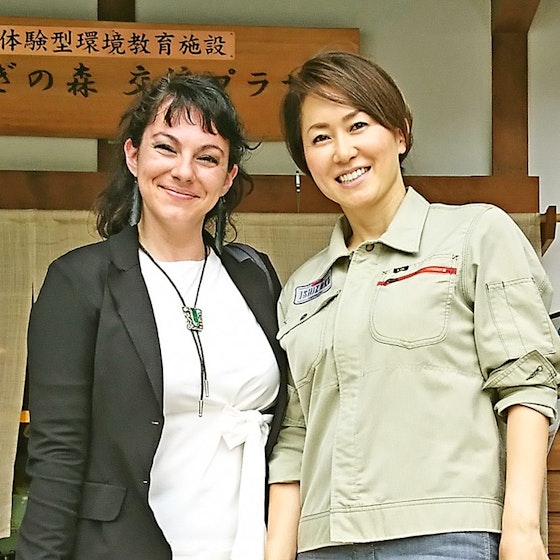
Monique Mares, USDA Organic Affairs Officer, visits our company
Agricultural producers around the world are beginning to adopt organic farming. Monique Mares is a promoter of organic farming, contributing to its development by continuing to communicate the importance of organic farming and the current challenges it faces. This was a valuable exchange of opinions on the organic field.
I felt that we needed to change the world of food, including our current eating habits, through organic food .
Ishizaka: Our company also has a strong interest in agricultural products, especially the organic world. First of all, I’d like to ask you how you got involved in your current job in the organic field.
Monique : Food has been a part of my daily life since I was a child. My grandmother grew and harvested vegetables on her own farm, and her living expenses depended on the yield, so food was her livelihood. We communicate with people through food. My interest in food was influenced by my childhood experiences.
My starting point was communities such as farms. That’s how I began to see society. I chose my academic field at university and my job to focus on food. The reason I decided to work in this field was because I strongly felt that the world of food, including our current eating habits, needed to change. Unlike the regular food field, the organic world requires a fundamental review of not only the production process but also the system, including distribution. I find this very rewarding.
Ishizaka: I think it’s common for people to become interested in “food” through eating, but it’s interesting that, given your upbringing, you became interested in the process by which food is sold. Your standards for life choices and aspirations are unique and intriguing. In that context, what made you think the organic sector was particularly important?
Monique: When I was a university student, I had the opportunity to study CSR and travel to South America. There, I learned something very shocking. In South America, it was commonplace for production processes to be carried out without any consideration for the health of agricultural producers. Even though it was clear that this production method was inevitably damaging to the health of agricultural producers, no one was able to improve the situation and just sat back and did nothing. Everything revolved around production, and I realized that the imbalance was a major issue.
Ishizaka : I see, so you had that experience. What percentage of American agriculture today is based on strict production practices like organic farming?
Monique: Currently, organic production accounts for 5% of consumption, but only 1% of farmland. The rest is produced using conventional methods. Looking at the global situation, the country with the highest rate is Denmark at 11%. Switzerland is the country that invests the most in organic production.
Innovative agricultural practices
are beginning to emerge in organic production.
Ishizaka : I once had the opportunity to visit a Japanese izakaya where they were turning food waste into compost, and the only fruit that remained was American grapefruit. In your experience of observing food from around the world, have there been any shocking events?
Monique: Of all the different agricultural production methods, those who choose organic have a strong sense of awareness. That’s why they make various efforts and attract many people. This is a trend that can be seen all over the world. Conversely, if you use conventional production methods, the land will gradually become depleted and production will become impossible. Eventually, you will have to leave the land. Even in this situation where the percentage of organic producers is low, innovative agricultural initiatives are actually taking place in organic production sites.
Ishizaka: How conscious are Americans actually of choosing organic food?
Monique: The growth rate in this sector is 10.5%. The growth rate of conventional tourism agriculture is 0.6%, so it can be said that organic agriculture has a higher growth rate. Producing a lot of food on a small amount of land, like tourism farms, also produces a lot of waste. Unlike grapefruit, which does not spoil, organic products decay quickly. For this reason, it is important to manage the entire production process and devise ways to avoid generating waste.
Rather than placing emphasis on “quantity,”
we must raise consumer awareness of “quality.”
What kind of vision do you have in mind, and what kind of system do you want to achieve?
The ideal system, including Monique’s production process, is one that “uses and utilizes everything available.” I believe it’s important to think in a multifaceted way about what comes out of the market and recycle it. For example, while there are only a limited number of products that can be distributed to famous restaurants, there are many other ways to distribute them if we look at the market as a whole. “Creating an organic market” cannot be achieved solely by farmers and distributors. It requires consumer awareness, and consumers themselves must understand, approve, and support the organic production process. This means raising awareness of “quality,” not just of organic food, but also of recycling, and not placing emphasis on “quantity.” A major challenge in the United States is its emphasis on mass production, using chemicals to extend the shelf life of food, and pursuing economic rationality. This makes it difficult to change attitudes.
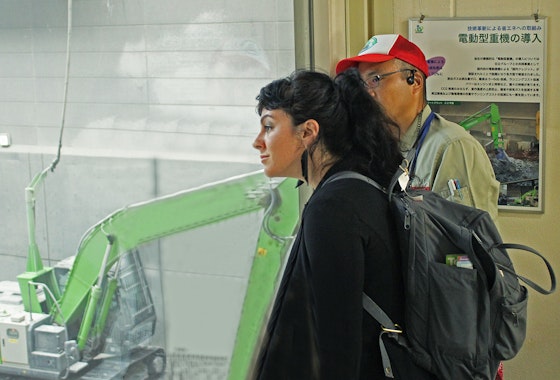
Ishizaka: Japan is becoming more Americanized, and values are becoming more economically driven. The same is true for the industrial waste industry; proper disposal is not possible unless consumer awareness and values change. I feel that the underlying issues are exactly the same as those in the organic market. I believe that change in these values will not occur unless education changes.
Before visiting Monique Ishizaka Sangyo, I had a chance to look at their website carefully. I was struck by the message on the website: “Respect, don’t neglect.” The same goes for food. Many consumers think that food is fine as long as it’s cleanly washed and packaged, like the vegetables lined up in the supermarket. However, I feel that few people are aware of the efforts of the people behind the scenes. The efforts and hardships of farmers who produce in the fields, covered in dirt every day, and those who work in distribution to get products to stores quickly are not well understood. I believe that only when this background is properly understood and respected can good relationships be created. I believe it is my job to make that happen.
Ishizaka: I completely agree. The challenge is how to visualize the background behind the scenes, and I feel that communicating that is extremely difficult.
Monique: In Japan, there is a word called “mottainai” (waste not worth) and it is deeply rooted in the culture. There is no such culture in America.
Organic farming is a labor-intensive process,
but in the United States,
there has been a movement in recent years to support organic farmers.
Ishizaka: Is there a trend among American farmers and producers to produce organic products? Are there many who want to produce but have given up because it’s not economically rational, or is there no such awareness at all? In Japan, producers say they want to produce good products but can’t afford it due to financial constraints.
Monique Organic employs 24,000 farmers, 80% of whom are small- to medium-sized businesses. It takes a strict three-year period to transition from conventional farming to organic. Farmers cannot transition unless they are certified as having properly conducted production activities within the specified conditions for three years. Farmers must farm within the specified conditions without using pesticides during this time, which requires a great deal of energy. Surviving this period is also financially difficult.
In the United States, there is a movement to support farmers during this period. Once they get through these three years, organic farming is basically viable to a certain extent, and sales increase by about 33%. Getting to this point makes it possible to continue as an organic farm, but sustaining this period is difficult.
Ishizaka: It’s been two years since our company started farming. It’s been less than three years since we started organic farming, so we haven’t been certified organic yet, but we have obtained GLOBAL GAP and ASIA GAP certification. However, it could be said that we are currently in the most difficult period. How do GLOBAL GAP and ASIA GAP rate our products from the American perspective?
As for Monique GAP, I think it’s true that Europe is more advanced and has adopted it more widely. The United States has its own unique certification system, so comparing it with GAP and adopting it would probably take time, as there would be issues with switching systems. There are also market differences. Europe has a low self-sufficiency rate and relies on imports. In contrast, the United States has a high rate of domestic production. Due to these differences in environment, whether imported products are GAP-certified or not is a good indicator of quality in Europe, and I think such a system was necessary. That’s why supermarkets also seem to place importance on whether a product is GAP-certified.
If people can understand through experience and education that “organic has social value,”
we will be able to grow even more in the future.
In terms of market size, the United States is the largest market. From a monetary perspective, it’s a 47 trillion yen market. Consumers tend to judge tourism agriculture and organic products solely based on the price and appearance of the product, but if we go a step further, it would be good if they could understand the social value of purchasing these products. If we can’t successfully cultivate this awareness, it will be difficult to grow.
Ishizaka: In terms of fostering awareness, what is lacking in Japanese education is the opportunity to experience things. For example, I think we should teach through experience that crooked cucumbers are delicious. The “straight cucumbers” lined up in supermarkets are the norm. Because we have a strong belief that “this is a delicious cucumber,” we end up in a vicious cycle of only growing straight ones. We should have children grow “good vegetables.” I think we need to learn through more experience.
Monique: Japanese vegetables are high quality, even at low prices. I think Japan has the best cost performance in the world. I think people overseas tend to underestimate Japanese food and have a one-sided view of Japanese cuisine. We need to look at it with a higher standard of value. On the other hand, Japan also has the highest food waste in the world. I think that’s a problem. I feel we need to reduce food waste. Many restaurant chefs should be more aware of this reality. The challenge in the United States is that the retail industry is too powerful. Supermarkets are brainwashing consumers. Our sense of taste is also becoming distorted. It’s also a problem that flavors containing a lot of chemical seasonings have become the norm, and children don’t know how food is made, so they think milk is made in the supermarket… Educating people about the facts and awareness of food is important in both countries.
Ishizaka: Experiences and education. There are still many issues that need to be addressed through food. Thank you very much for your valuable information and opinions.
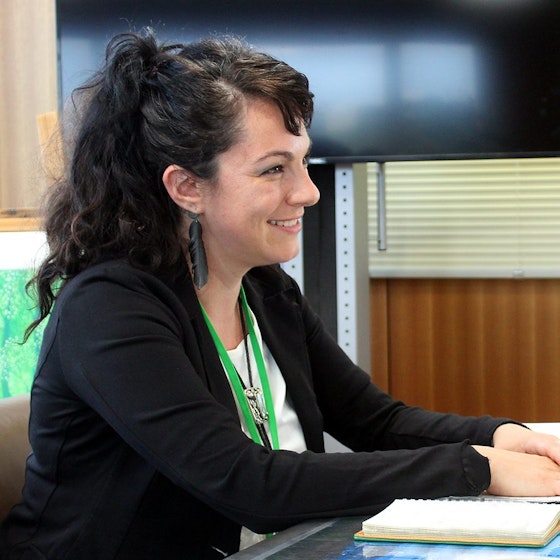
◇ Monique Marez / Profile
Organic trade association Monique Marez Director INTERNATIONAL Trade
United States Department of Agriculture Organic Foods Director Monique Marez (33 years old)
International Trade Director.
This time she came to Japan as a speaker at an organic life event for the purpose of press relations as the organic department of the US Department of Agriculture. This is the first attempt by the US Department of Agriculture to communicate overseas.
Facility Tour and Training Program
We offer factory tours throughout the year that are open to all visitors.Our programs include tours designed for adults, family-friendly tours for parents and children, as well as tours tailored for companies and organizations.We provide customized courses based on your needs, including the theme, budget, and available time.
Contact Us
For inquiries regarding industrial waste acceptance, media interview requests, or consultations about collaboration and partnerships, please contact us here.